BaseRobinhood·246,886holders·Tokenization is here ·1.05%($5.3K)burned, gone forever·2.10%($10.4K)bought back by AMI·29.32%($145.7K)staked, out of circulation·9.86%($49K)potential flywheel buyback·AMI dashboard ·
BaseRobinhood·246,886holders·Tokenization is here ·1.05%($5.3K)burned, gone forever·2.10%($10.4K)bought back by AMI·29.32%($145.7K)staked, out of circulation·9.86%($49K)potential flywheel buyback·AMI dashboard ·
TurboUSD was created to reject currency debasement while benefiting from the growth and adoption of stablecoins. The old system sells the illusion of stability. We take the opposite position: a finite, deflationary, openly unstable asset that lives inside the things dilution makes more expensive.
Stablecoins inherit the dollar's flaw and sell it as a feature. ₸USD inverts it: finite, deflationary, openly unstable, and priced in what the printing makes expensive.
01USD & Stables · inflate
The dollar and stablecoins have a design flaw
They print. Every new dollar dilutes the ones you hold, and the loss hides inside the word “stable”. Stablecoins took that flaw onchain, wrapped it in a token and sold it as innovation.
02₸USD · buys back + burns
₸USD is the same concept, inverted
A fixed supply of 100 billion, no peg, and an autonomous treasury that buys back and burns supply with trading fees; while staking keeps even more off the market with locks. It cannot be printed. It can only shrink.
03anchored · hard assets
Priced in what the printing pushes up
₸USD is quoted against ETH, never a dollar, and it is the reserve currency of MemeStock.market: every memestock there is launched against half ₸USD and half real tokenized stocks and allied tokens. The world is tokenizing more of them every day.
$5.2B → $301.5B since 2020 (58×). Its holders made exactly 0%.
i
THE SECTOR: $5.2B → $301.5BYOUR USDC: $1.00 → $1.00
Stablecoins adoption
The wave you can't ride
Stablecoins are taking crypto mainstream: hundreds of billions of dollars, growing every year, headed for every wallet and payment rail. But by design, 1 USDC is worth $1 today, $1 next year, $1 forever. You can watch the sector 10× and own none of it, while the dollar underneath keeps diluting. Stablecoins inherit the dollar's design flaw and sell it as a feature.
₸USD rides the same adoption wave with the flaw inverted: a dollar-shaped asset for the onchain economy that cannot be printed, only burned and bought back, priced in the assets the printing inflates. The upside stablecoins throw away is the point.
Two numbers, two directions
i
The Fed · M2 money supply
US dollars in existence
▲$23,342,800,000,000
+$39,616 every second
since you opened this page: …
AMI · Burn engine
₸USD in existence
▼98,947,950,095 ₸
−46.79₸ every second
since you opened this page: …
Market Scale
TurboUSD Unstablecoin · today
$486,929
All of ₸USD, priced by the market today: one fixed supply of 100 billion, no peg, and a treasury that only ever shrinks it.
Stablecoins · today
$302 billion
619,262× bigger. The same dollar-shaped product with the flaw the other way round, already in every wallet.
US dollars · M2
$23 trillion
47,938,838× bigger. Every one of them losing value to the printer. Still think you are late?
TurboUSD UnstablecoinStablecoinsUSD · M2
TurboUSD Unstablecoin$486,929
Stablecoins$301,536,578,106↑︎ 619,262×
USD · M2$23,342,800,000,000↑︎ 47,938,838×
The meta with no end
Every token needs a trend. We just need the printer.
Trends expire. Narratives rotate. Sectors get crowded and die. This one runs on the single thing the system cannot stop doing: debt has to be rolled, deficits have to be funded, and every crisis gets answered the same way, by every central bank, in every currency, with more supply. There is no version of fiat where that ends, and nobody is proposing one.
Trends expire. The printer does not. Debt has to be rolled and every crisis gets answered with more supply, in every currency, by every central bank.
1,962
years of currency debasement, and counting
195/195
countries running on flawed fiat money
0
central banks with a plan to stop
It has never stopped
And it cannot stop.
Debasement is not a policy mistake waiting to be corrected. It is how states have funded themselves for as long as money has existed, and every paper currency in history has ended the same way. The ones still alive are simply not there yet. The printer is not a phase of the cycle. It is the cycle.
64 ADNero clips the denarius1545Spanish silver floods Europe1797England suspends gold1933Gold called in by decree1971The dollar leaves gold2008Quantitative easing begins2020+$6T in two yearsNextWhatever they call it then
Swipe the timeline · tap any year for the story
64 ADNero clips the denarius1545Spanish silver floods Europe1797England suspends gold1933Gold called in by decree1971The dollar leaves gold2008Quantitative easing begins2020+$6T in two yearsNextWhatever they call it then
TurboUSD was built on a thesis that breaks with conventional logic. It emerged during the rise of stablecoins, but as digital dollars expand, much of the sector reproduces the same failed logic as fiat onchain: centralized trust and monetary debasement hidden beneath the language of stability. We take the opposite position.
₸USD sits at the center of an interconnected system where every component functions as part of a shared architecture. As the project expands, growth, usage and engagement accumulate into value around a single asset, allowing each layer to reinforce the others.
A hard asset on the inside, priced in hard assets outside.
Tokenization is what makes both sides possible. Inside, ₸USD is a tokenized hard asset itself: a fixed supply that only shrinks. Outside, it is quoted against ETH and it is the money of MemeStock.market, where every memestock is launched against a reserve of half ₸USD, a quarter blue-chip tokenized shares and a quarter allied tokens — the things that get more expensive the more dollars are printed. Not every tokenized asset works like that: a tokenized bond is still paper that pays you back in dollars.
Tokenization makes both sides possible: ₸USD is a tokenized hard asset with a supply that only shrinks, quoted against ETH and held beside blue-chip tokenized shares in every MemeStock.market reserve.
The tokenization wave
Sep 17, 2026SEC
Onchain venues may trade tokenized stocks, with AMMs and liquidity pools.
Stocks, metals and funds are moving onchain, and regulators are writing the rules. ₸USD was built for this moment: priced against the assets being tokenized, with a treasury run by smart contracts and an AI agent that executes in DeFi.
Priced in tokenized assets
₸USD is quoted against ETH, and it is the reserve currency of MemeStock.market: every memestock is launched against half ₸USD and a half made of real tokenized shares and allied tokens. The more of the economy goes onchain, the more of it ends up in those reserves.
₸USD is a tokenized hard asset in its own right: a fixed supply of 100 billion that can only shrink. Two engines work on it. Every trade feeds the BurnEngine, which burns its fees automatically; and between trades too, AMI keeps the treasury working: buybacks, burns, rebalances and locks.
Demand
01
246,886
holders · all chasing one supply of 100B ₸
Interest in the token and the market itself, plus everything built around it: the first unstablecoin, its memes, TurboX Energy, the Turbo Node and AMI, the first Monetary AI.
Volume
02
$3.5M
traded since launch
Demand becomes trades on Base, in the pool ₸USD is quoted in.
Fees
03
1%
of every trade · ≈$35.2K generated
Every trade pays a 1% fee, collected in WETH and ₸USD.
↻ Every turn leaves less ₸USD for the next one
Less supply
06
69.93B ₸
on the market, from 100B at step 01
▼ 30.1%supply▲ +2,699%price since launch
Fewer ₸USD left for the next wave of demand, burned and staked, and the loop starts again.
Treasury + AMI
05
Bought back
2.08B ₸
Burned
1.05B ₸
Locked in treasury
2.00B ₸
With the treasury's WETH, USDC and strategic tokens ($13.7K managed), AMI buys back, burns and rebalances into buybacks. Every ₸USD that lands in the treasury is locked for good: it can be burned or staked, never sold.
BurnEngine
04
95.69M ₸
burned in 5 cycles
Automatic and permissionless. In one transaction it claims the fees, buys ₸USD with the WETH and burns it, together with the ₸USD it claimed.
Demand
01
246,886
holders · all chasing one supply of 100B ₸
Interest in the token and the market itself, plus everything built around it: the first unstablecoin, its memes, TurboX Energy, the Turbo Node and AMI, the first Monetary AI.
Volume
02
$3.5M
traded since launch
Demand becomes trades on Base, in the pool ₸USD is quoted in.
Fees
03
1%
of every trade · ≈$35.2K generated
Every trade pays a 1% fee, collected in WETH and ₸USD.
BurnEngine
04
95.69M ₸
burned in 5 cycles
Automatic and permissionless. In one transaction it claims the fees, buys ₸USD with the WETH and burns it, together with the ₸USD it claimed.
Treasury + AMI
05
Bought back
2.08B ₸
Burned
1.05B ₸
Locked in treasury
2.00B ₸
With the treasury's WETH, USDC and strategic tokens ($13.7K managed), AMI buys back, burns and rebalances into buybacks. Every ₸USD that lands in the treasury is locked for good: it can be burned or staked, never sold.
Less supply
06
69.93B ₸
on the market, from 100B at step 01
▼ 30.1%supply▲ +2,699%price since launch
Fewer ₸USD left for the next wave of demand, burned and staked, and the loop starts again.
₸USD trades against ETH, never against a dollar. And it is the reserve currency of MemeStock.market: every memestock is launched against a basket that is half ₸USD, a quarter the company's real tokenized stock and a quarter selected tokens. The hard assets do not sit opposite ₸USD — they sit beside it, and every trade in that market burns ₸USD by the same weight. This half comes from outside the token.
Ethereum▲1192%
The pair ₸USD trades in, in a renounced pool. Every trade prices ₸USD against ETH, never against a dollar.
Its roleThe pair
Tokenized stocks▲866%
Apple, Nvidia, Google and the rest of the companies the printer keeps repricing upward, issued onchain and held by each memestock's own contract.
In every reserve25%
Selected tokens▲ Variable
Allied projects and communities, chosen in each memestock's prospectus and changeable by holder vote within safety limits.
In every reserve25%
₸USD itself▲ Variable
Half of every reserve. Each launch buys it, each trade there burns it by the same weight, and its own supply only shrinks.
In every reserve50%
How the printer lifts ₸USD ↓
The printer
+$39,616/s
new dollars · M2 +5.7% a year
Every new dollar dilutes the ones already out there, and the loss shows up as higher prices.
Hard assets reprice
▲ Ξ, stocks, tokens
what the new money chases
The assets with real scarcity or real earnings absorb the new money: they are what gets more expensive.
The reserves gain
▲ 50/25/25
every memestock reserve
Each memestock is launched against half ₸USD, a quarter its company's tokenized stock and a quarter allied tokens: when those rise, the reserve behind it is worth more.
₸USD rises with its anchor
▲▲ ₸USD
the pair, and the reserve
It is quoted against ETH, bought for half of every basket and burned by that same weight on every trade there, with a supply that only shrinks.
The anchor is what ₸USD is quoted against and held beside; the treasury is what AMI works with. It holds WETH, USDC and strategic tokens, and none of it backs ₸USD: it is spent on buybacks, burns and locks. The strategic tokens are the triggers, rebalanced into direct buybacks when they rise.
Treasuries, mortgage bonds and promises — every asset on this sheet is denominated in the thing it prints. When the printer runs, the sheet grows and each dollar on it buys less. Holders of dollars pay the difference.
US TreasuriesUS Treasuries · $4.6T · 67.7% Government debt: IOUs that pay back in dollars the same institution can print.Mortgage-backed securitiesMortgage-backed securities · $1.9T · 28.1% Bundled home loans bought to pin interest rates down — paper on paper.OtherOther · $285.8B · 4.2% Loans, swap lines, repo and the rest of the toolbox. Also dollars.
WETH, USDC, strategic tokens and ₸USD itself. AMI spends them on buybacks, burns and locks, and the ₸USD that lands here is locked for good. No promises on the sheet, only assets and receipts.
Strategic tokensStrategic tokens · $3.5K · 25.3% Tokens bought by AMI for the treasury. When one of them rises, the position is sold to fund a ₸USD buyback.DRB$1.7K · 49%BNKR$1K · 30%KELLY$481 · 14%CLAWD$229 · 7%₸USD (locked)₸USD (locked) · $10.1K · 73.6% ₸USD held by the treasury: bought back from the market, OTC or with the proceeds of a strategic position. The contract cannot sell it: it can only be burned or staked.USDCUSDC · $155 · 1.1% Dry powder in dollars, waiting for the next operation. The only paper on this sheet.
$13,732 managed · every move receipted on Basescan
i
Strategic tokens · buyback triggers
When these tokens rise, ₸USD supply falls.
The treasury holds these tokens as triggers, not as a bet. When one of them rises, AMI rebalances it and buys ₸USD off the market with the proceeds: a direct buyback, on top of what the BurnEngine already burns from every trade.
The mechanism that makes it appreciate like a hard asset.
Stablecoins are paper priced in paper, and so is any token that only wraps a dollar or a bond. ₸USD is priced in the hard assets that go up the more dollars are printed every year. Rejecting dilution is easy to say; living inside what dilution makes more expensive is the mechanism that makes it real. Dollar on the outside. A different engine underneath.
1960 → today · The Fed
The printer never stops.
Since 1960 the dollar supply has multiplied 78×. A 1960 dollar buys 9¢ today. Nothing was built with the new money. It was printed, and every dollar you hold was diluted by it.
Priced in a shrinking unit
So everything priced in dollars goes up.
The S&P 500: 131× in dollars over the same period. Better companies, yes — and a ruler that keeps getting shorter. Every dollar printed has to land somewhere, and it lands in assets. That is the side of the trade you want to be on.
Hard assets
The scarcer the asset, the harder it flies.
Apple, Amazon, Nvidia, Bitcoin, Ether — each from its first day of data. Fixed or slow supply against an ever-growing pile of dollars: the more they print, the more these are worth. The printer does the lifting.
The anchor
₸USD is priced in these. Not in dollars.
₸USD trades against ETH — never against dollars — and sits in the reserve of every memestock on MemeStock.market, beside the real tokenized shares and tokens that make up the other half. When they rise, ₸USD rises with them. Then burns, buybacks and staking locks take supply off the market, and every one of them pushes the price further.
i
i
The Deflation Edge
How much of each asset exists over time, base 100.
Same story, in supply
Scarcity by design. Supply only shrinks.
Gold and bitcoin are scarce because their supply barely grows. ₸USD goes one step further: its supply only ever shrinks. Every trade pays a fee that the BurnEngine turns into burned ₸USD. On top of that, AMI buys ₸USD back with the treasury, OTC and by rebalancing a strategic token that hit its trigger, and staking keeps what is left off the market. Against a dollar that adds trillions a year, that is the whole edge.
The Fed prints paper. AMI stacks what paper buys less of. TurboUSD extends beyond a static token model through AMI, an AI agent designed to observe, interpret and act: it monitors macroeconomic signals, policy decisions, market conditions, treasury balances and internal ecosystem dynamics, and turns them into structured decisions executed onchain.
External signals
CPI and inflation
Interest rates & Fed statements
Stablecoin supply
USD monetary expansion
Employment releases
Market volatility
Internal metrics
Treasury balances & composition
₸USD circulating and locked supply
Staking participation
Burn activity and pace
Buyback history
Prior AMI actions and outcomes
AMI 9000
Reads the signals, weighs them against objectives, treasury limits and policy rules, and executes the decision onchain. Memory of every past cycle sharpens the next one.
MonitorDecideAct
Buy ₸USD
Buyback from the pool
Reinforce supply
Burn or stake
Preserve capital
Hold or rebalance
No action
Conditions don't justify it
→ executed onchain · written to memory ↺
Accountable by design
Transparent rules. Visible execution.
Unlike institutions such as the Federal Reserve, where decisions are opaque and detached from ordinary participants, AMI is built around a clear objective: managing treasury behavior to strengthen the ecosystem and support ₸USD holders over the long run. It operates within defined policy boundaries and treasury limits, refining its behavior over time through prior outcomes and new information.
Every decision is a transaction. Every transaction is a receipt. The log on the right is not a simulation.
We don't just talk about Unstability, we make it tangible by turning ideas into objects and onchain culture into a brand that exists beyond the screen. Most onchain projects live and die inside interfaces. We chose a harder path.
We turn Unstability into objects and onchain culture into a brand that exists beyond the screen. Most onchain projects live and die inside interfaces.
Products→Experiences→Awareness→Brand grows↺
Real world · 01
TurboX Energy
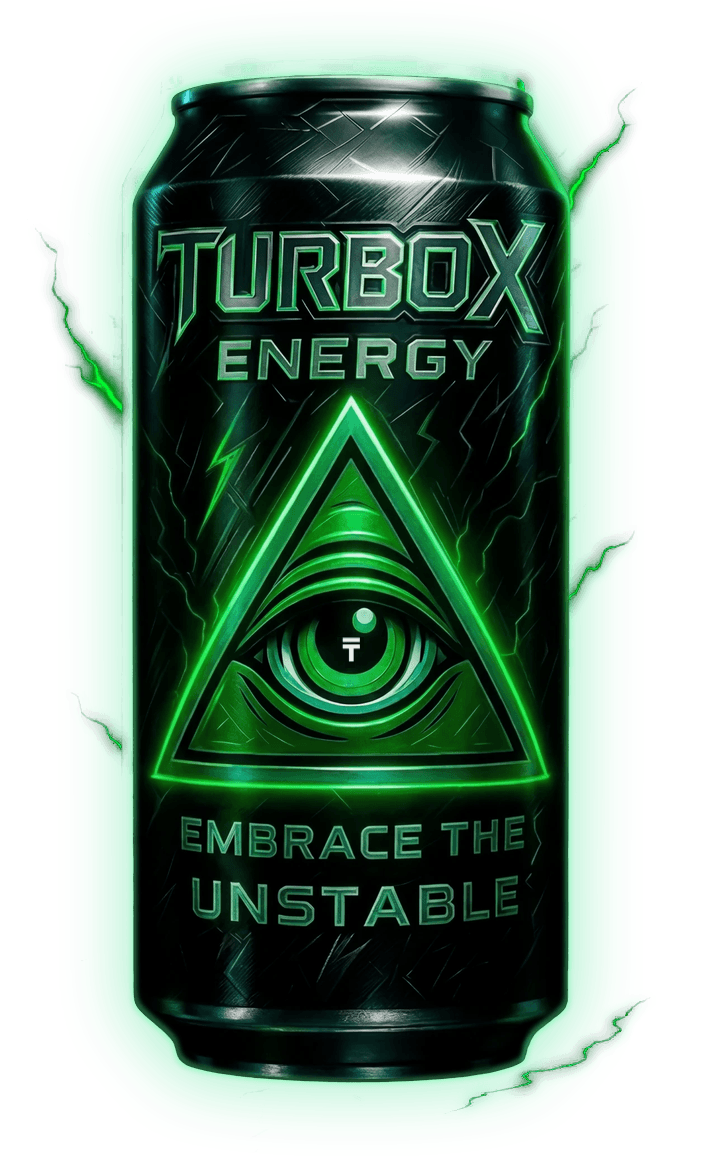
The unstable drink. A can you can hold, taste and hand to someone who has never opened a wallet.
Alignment with a brand and its cultural IP, not just a contract.
Beyond crypto
Reach and recognition where wallets and charts don't exist.
Distribution as opportunity
Community members and partners expand the brand while creating real-world upside for themselves.
Built to last
Products, presence and memory compound value across cycles.
Cultural movement
Building a strong collective identity.
A brand becomes culture when people do more than recognize it. They repeat it, remix it, rank themselves inside it, build around it, and carry it into public spaces through content, symbols and shared references. Through memes, commentary, symbolic imagery and the Cult of Chaos, TurboUSD makes participation visible and belonging legible.
A brand becomes culture when people repeat it, remix it and carry it into public spaces. Memes, symbols and the Cult of Chaos make participation visible and belonging legible.
The ecosystem already has its foundations: economic thesis, onchain intelligence, products and real-world presence. The cultural layer turns those foundations into collective identity, with its own language and recognizable form. That gives it durability beyond any single cycle.